

→ LEARN MORE: Seeing is NOT believing…
This month, we summarized all of our lessons that we’ve learned throughout the year into one topic: faith. We spoke about what faith is (and what it is not), how we can grow in our faith, and how we can live our faith in the ordinary parts of our lives. We talked about how important it was to have our foundation in our faith when times get difficult in order to lead us through.
Faith is a gift from God, but is not something that remains the same; it ebbs and flows as we grow, but we can never lose it. Even if we sometimes feel like we lost our faith or we are doubting, the beauty about the gift of faith is that it can never be lost. Watch this video by Fr. Mike Schmitz regarding faith:
Faith is Not Something You Can Lose
→ MONTHLY LECTIO DIVINA: Isaiah 41:1-20
Listen to me in silence, O coastlands;
let the peoples renew their strength;
let them approach, then let them speak;
let us together draw near for judgment.
Who has roused a victor from the east,
summoned him to his service?
He delivers up nations to him,
and tramples kings under foot;
he makes them like dust with his sword,
like driven stubble with his bow.
He pursues them and passes on safely,
scarcely touching the path with his feet.
Who has performed and done this,
calling the generations from the beginning?
I, the Lord, am first,
and will be with the last.
The coastlands have seen and are afraid,
the ends of the earth tremble;
they have drawn near and come.
Each one helps the other,
saying to one another, “Take courage!”
The artisan encourages the goldsmith,
and the one who smooths with the hammer encourages the one who strikes the anvil,
saying of the soldering, “It is good”;
and they fasten it with nails so that it cannot be moved.
But you, Israel, my servant,
Jacob, whom I have chosen,
the offspring of Abraham, my friend;
you whom I took from the ends of the earth,
and called from its farthest corners,
saying to you, “You are my servant,
I have chosen you and not cast you off”;
do not fear, for I am with you,
do not be afraid, for I am your God;
I will strengthen you, I will help you,
I will uphold you with my victorious right hand.
Yes, all who are incensed against you
shall be ashamed and disgraced;
those who strive against you
shall be as nothing and shall perish.
You shall seek those who contend with you,
but you shall not find them;
those who war against you
shall be as nothing at all.
For I, the Lord your God,
hold your right hand;
it is I who say to you, “Do not fear,
I will help you.”
Do not fear, you worm Jacob,
you insect Israel!
I will help you, says the Lord;
your Redeemer is the Holy One of Israel.
Now, I will make of you a threshing sledge,
sharp, new, and having teeth;
you shall thresh the mountains and crush them,
and you shall make the hills like chaff.
You shall winnow them and the wind shall carry them away,
and the tempest shall scatter them.
Then you shall rejoice in the Lord;
in the Holy One of Israel you shall glory.
When the poor and needy seek water,
and there is none,
and their tongue is parched with thirst,
I the Lord will answer them,
I the God of Israel will not forsake them.
I will open rivers on the bare heights,
and fountains in the midst of the valleys;
I will make the wilderness a pool of water,
and the dry land springs of water.
I will put in the wilderness the cedar,
the acacia, the myrtle, and the olive;
I will set in the desert the cypress,
the plane and the pine together,
so that all may see and know,
all may consider and understand,
that the hand of the Lord has done this,
the Holy One of Israel has created it.
Questions to Consider
- This passage from Isaiah comes at a time in ancient Israel’s history when they were enslaved by the Babylonians and had lost their homeland, their culture, everything except their faith. They were wondering if God was still there with them since they felt so far from him. Have you ever felt in your faith journey when God was really close to you or really far away? What was that like?
- In Isaiah, we see that God has always remained with the Israelites, even when they chose to separate themselves from him. Recall a time when you forgave someone or someone forgave you. What was that like?
→ MONTHLY VISIO DIVINA: Divine Mercy by Eugene Kazimierowski
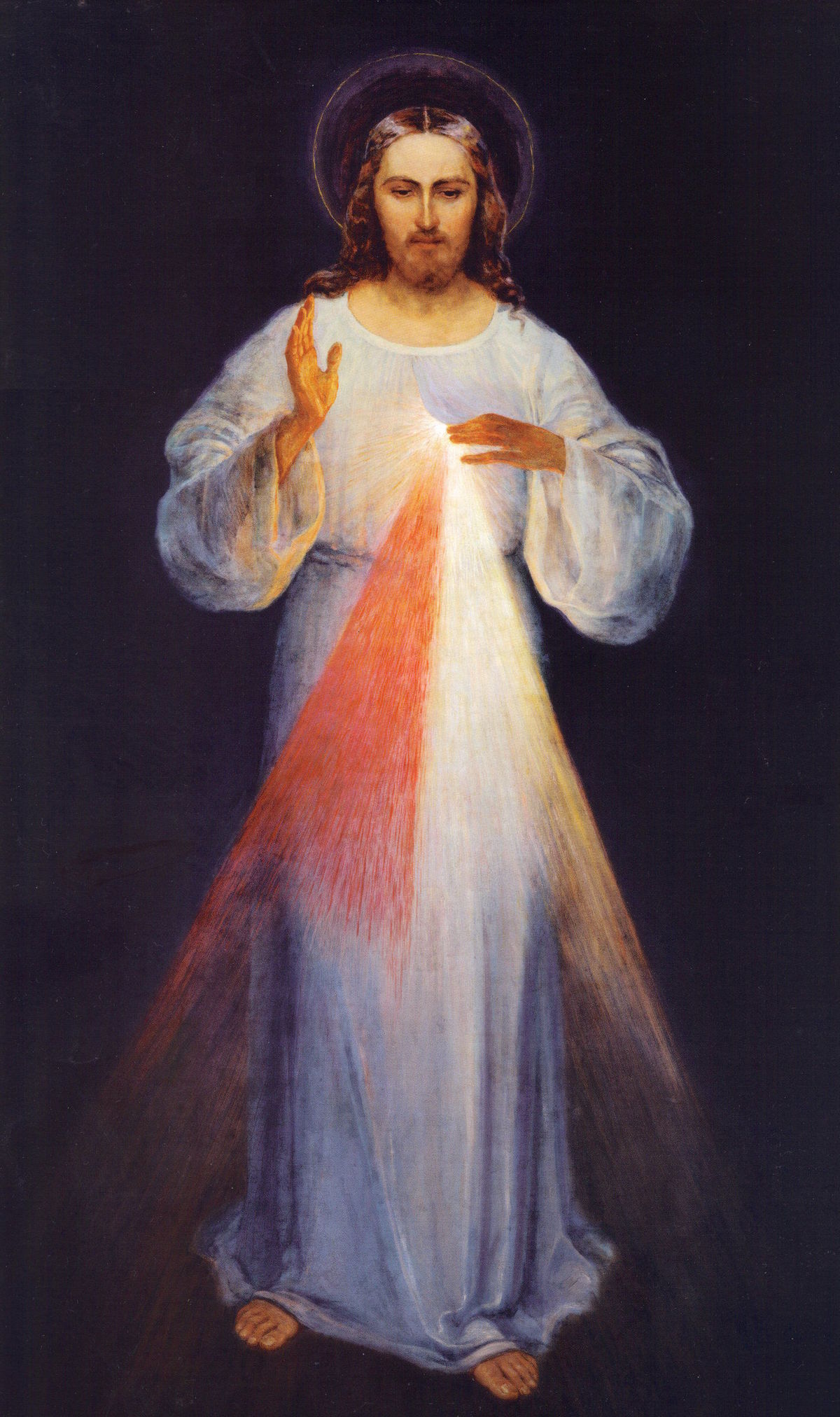
About this piece
The Divine Mercy Image of Jesus is not another ordinary holy picture of Jesus. It is an image Jesus Himself revealed to St Faustina and commanded her to have it painted.
Jesus promised many graces to those who venerate this Image and wanted it made known throughout the whole world. Because of German and then Soviet occupations and the ruthless tyranny of those regimes over religious expression, the original painting from 1933 was lost only to be rediscovered decades later. In that period of time hundreds of versions of the image were painted but of them all the original image is faithful to the particular vision given to St. Faustina.
First, Our Lord's eyes are downcast while blessing. St. Faustina was told that His gaze is as though from the cross and so His gaze is downward. The rubrics for the Mass as celebrated in the 1930s, what today is called the Extraordinary Form, direct the priest to look toward the ground at particular moments of the Mass including while blessing.
Second, His right hand is raised in blessing and the hand’s height does not extend up past the shoulders nor does it extend further out from the right shoulder. This too imitates the directives of the Mass pertaining to both the blessing of people and the orans position.
Third, Our Lord is wearing a garment, what we can consider an alb which is cinctured as would a priest. Normally, while blessing, a priest wears a stole. Here, of course, Our Lord does not wear a stole. A stole is a sign of office and authority, but Christ Himself is the office of the priesthood, He Himself is the authority.
Fourth, the model for the painting was a priest, Fr. Michael Sopocko, and appropriately so. A priest stands in a privileged way as Christ the Divine Mercy, particularly in the sacrament of reconciliation and generally when blessing. The priest serves as alter Christus (other Christ): in the sacrament, in the painting.
(Source: https://churchlifejournal.nd.edu/articles/liturgical-elements-in-the-divine-mercy-image/)
Questions to Consider:
- What catches your eye about this picture? Describe why it catches your eye. What do you think God is trying to tell you through this? How do you see yourself in this picture?
- The image of Divine Mercy shows to us that Jesus’ poured out his body and spirit (evidenced by the red and white light) for us. Knowing that Jesus’ mercy is ever available to us, we can be confident that no matter how much we separate ourselves from Christ, his hand is always outstretched waiting for us to return back. How does this make you feel?
HOMEWORK
- Write a reflection on Isaiah 41:1-20 and Divine Mercy using the questions as guidance (3-5 sentences for each).


