

→ LEARN MORE: How should I act towards people I don’t like?
This month, we spoke about how to live a Catholic life and make decisions according to what God has asked us to do. We learned that there is an objective truth — meaning, an unchanging sense of right and wrong — and that we are called to form our conscience. We reviewed the 10 Commandments and learned that they’re not just a list of “can and cannots,” but rather a list of ways we can live in a healthy and loving relationship with God and with others. We learned that as we get older, we are given more freedom—and therefore more responsibilities—and it’s up to us to form our conscience to make the right decisions. When we make a good (or bad!) choice, we are creating habits that eventually become our character; in other words, if someone who didn’t know me saw how I was acting, what would they think about me?
Oftentimes, it’s easy for us to act “right” towards people we know love and care about us (or we care about!). It is much more difficult to act “right” towards people who we don’t like, are in conflict with, or—let’s be frank—just plain annoying! Jesus calls us to love everyone–no exceptions. But, how do we do that? Watch this video on how to deal with conflict in relationships by The Bible Project:
“Conflict in Relationships Is Unavoidable” • Jesus Offers Wisdom for Seeking Peace
→ MONTHLY LECTIO DIVINA: Luke 15:11-32 (Parable of the Prodigal Son)
Then [Jesus] said, “A man had two sons, and the younger son said to his father, ‘Father, give me the share of your estate that should come to me.’ So the father divided the property between them. After a few days, the younger son collected all his belongings and set off to a distant country where he squandered his inheritance on a life of dissipation. When he had freely spent everything, a severe famine struck that country, and he found himself in dire need. So he hired himself out to one of the local citizens who sent him to his farm to tend the swine. And he longed to eat his fill of the pods on which the swine fed, but nobody gave him any. Coming to his senses he thought, ‘How many of my father’s hired workers have more than enough food to eat, but here am I, dying from hunger. I shall get up and go to my father and I shall say to him, “Father, I have sinned against heaven and against you. I no longer deserve to be called your son; treat me as you would treat one of your hired workers.”’ So he got up and went back to his father. While he was still a long way off, his father caught sight of him, and was filled with compassion. He ran to his son, embraced him and kissed him. His son said to him, ‘Father, I have sinned against heaven and against you; I no longer deserve to be called your son.’ But his father ordered his servants, ‘Quickly bring the finest robe and put it on him; put a ring on his finger and sandals on his feet. Take the fattened calf and slaughter it. Then let us celebrate with a feast, because this son of mine was dead, and has come to life again; he was lost, and has been found.’ Then the celebration began. Now the older son had been out in the field and, on his way back, as he neared the house, he heard the sound of music and dancing. He called one of the servants and asked what this might mean. The servant said to him, ‘Your brother has returned and your father has slaughtered the fattened calf because he has him back safe and sound.’ He became angry, and when he refused to enter the house, his father came out and pleaded with him. He said to his father in reply, ‘Look, all these years I served you and not once did I disobey your orders; yet you never gave me even a young goat to feast on with my friends. But when your son returns who swallowed up your property with prostitutes, for him you slaughter the fattened calf.’ He said to him, ‘My son, you are here with me always; everything I have is yours. But now we must celebrate and rejoice, because your brother was dead and has come to life again; he was lost and has been found.’”
Questions to Consider
- The word prodigal describes someone who spends their money wastefully, lavishly, and foolishly. The younger son takes his portion of the inheritance (essentially telling his father he wishes he were already dead), and after it runs out he returns and begs forgiveness from his father. If you heard about this story from a friend or family member, what would you think or say?
- The story of the Prodigal Son shows us the endless and radical love and compassion God has for His creation — especially towards those who we think do not deserve it. Have you ever been in a situation where you forgave someone who you did not think deserved it? What happened, and how did you feel?
- Do you find yourself in the position of the Prodigal Son, or the Son that remained with his father? Why do you think that is?
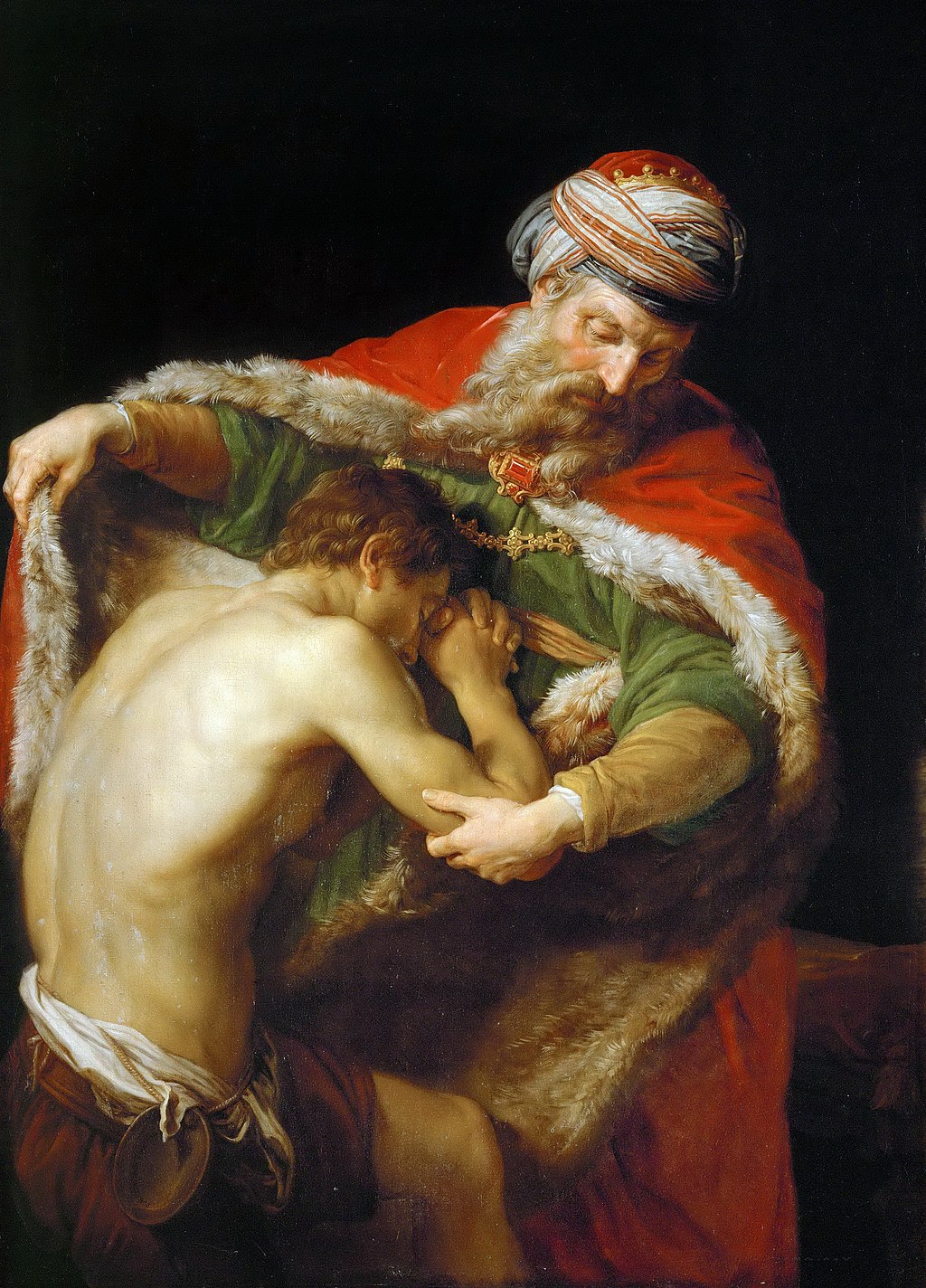
→ MONTHLY VISIO DIVINA: The Return of the Prodigal Son by Pompeo Batoni
About this piece
The biblical parable of the Prodigal Son tells of God’s mercy to a repentant sinner. Batoni depicts the return of the poor son to the arms of his father, who lovingly accepts him, laying his mantle protectively around the son’s shoulders. The painter thus makes particularly clear the meaning of this parable: that the one who repents is loved more.
(Source: https://www.khm.at/en/objectdb/detail/186/)
Questions to Consider:
- What catches your eye about this picture? Describe why it catches your eye. What do you think God is trying to tell you through this? How do you see yourself in this picture?
- Compare the prodigal Son and the Father. What is different about them?
- Notice the expression of the Prodigal Son. Notice the expression of the Father. What do they look like? Why do you think they have that expression? What does that expression say to you about the picture?
HOMEWORK:
- Write a reflection on Luke 15:11-32 and The Return of the Prodigal Son using the questions as guidance (3-5 sentences for each).


