
WHAT IS MY CHILD LEARNING THIS MONTH?
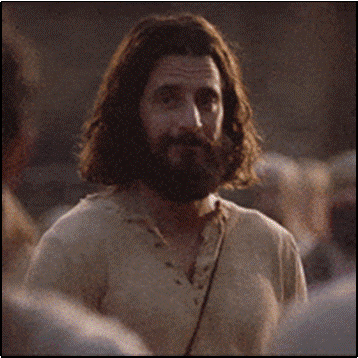
This month, we explored the question: “Who is Jesus?” We discussed how He is the Son of God—God made Man—and how he appeared to us in not the way we expected: as a poor, simple, and humble Jewish man as opposed to a rich and majestic king. We then spoke about what Jesus taught by examining the heart of his preaching, The Sermon on the Mount, in Matthew 5. We focused on “The Beatitudes,” a series of statements that show us what it means to be truly happy: by following Jesus in order that we spend eternity in Heaven with Him and His Father. The beatitudes follow a conditional statement, “Blessed are…,” followed by a result, “For they…” In small groups, students discussed how they could apply the beatitudes in their everyday lives and live them out in a practical way.
Terms we went over:
Beatitude: the beatitudes are “at the heart of Jesus’ preaching…they shed light on the actions and attitudes characteristic of the Christian life; they are the paradoxical promises that sustain hope in the midst of tribulations; they proclaim the blessings and rewards already secured, however dimly, for Christ's disciples” (Catechism of the Catholic Church, §1716-7). The Beatitudes teach us that God calls is this: the Kingdom of God, the participation in His divine and eternal life (See Catechism of the Catholic Church §1716-24).
“Poor in spirit”: the first beatitude Jesus gives in Matthew 5:3. To be poor in spirit is to rely on God for all things and not rely on the things of this world for happiness. Just as a poor person works each day for their food and relies on the generosity of others, we rely on the love and generosity of God for all things. Jesus starts The Sermon on the Mount with this phrase, so he highlights to us that “to be poor in spirit” is the foundation of what it means to be truly happy. This beatitude is often conflated with “Blessed are those who are sad/have little faith in God.” (See Catechism of the Catholic Church §1717-19)
Meek: the dictionary definition tells us that to be meek is to be submissive, weak, or “being a doormat” (Merriam-Webster). For Jesus, to be meek is to have one’s strength under control; meaning, to use your gifts for the good of others rather than evil. When we get angry, we are called to not impulsively lash out but to direct it towards the good. This, too, means to endure the trials and tribulations of life with a patient spirit, knowing and trusting in God’s justice and mercy.
BRINGING THIS SESSION HOME
This month, parents are asked to go over Jesus’ chosen twelve Apostles with their teenagers. The twelve Apostles were hand-picked by Jesus to carry out his mission on earth; they were the first bishops of the Catholic Church and were given authority and power by Jesus, including the power to heal and to forgive sins. The Pope today can be traced directly back to St. Peter and the other Bishops of the Catholic Church descend directly from the other Apostles (see Mt 16:19).
With your teenager, write down names of as many Apostles that you already know (see how you did!). There is a very easy way to remember the names of all twelve Apostles using the acrostic “BAPTISM.” A bit of an explanation before explaining the acrostic: During Jesus’ time, the common language spoken and written was Greek. In particular, Greek was the language of merchants and therefore those involved in business/interested in buying items needed to know Greek. Since it was spoken so often in commerce, everyone regardless of nationality began to use Greek all the time. Naturally, the Greek alphabet is very different from ours, with fewer and different letters. For example, the Greek alphabet doesn’t contain the letter “J,” so words with the letter “J” would be replaced with the letter “I.”
If we use the word “BAPTISM” as an acrostic, we can name all twelve Apostles very easily:
B: Bartholomew
A: Andrew
P: Philip, Peter
T: Thomas
I: (remember, the Greek Spelling!) Jude, Judas, John, James the Greater, James the Lesser
S: Simon (the Zealot)
M: Matthew
Let’s take a look at each of the Apostles:
St. Bartholomew: in John, he also goes by the name Nathaniel. In Matthew, Mark, Luke and Acts, he is referred to as Bartholomew. While we hear little of Bartholomew, we know of him primarily in John 1:44. When St. Philip called him to come meet Jesus, Nathaniel was skeptical but followed along anyway. As St. Philip introduced him to Jesus, the Lord declared: “Here is a true Israelite, in whom there is nothing false." Immediately Nathanael wanted to know, "How do you know me?"
Jesus answered, "I saw you while you were still under the fig tree before Philip called you." Shocked and surprised, Nathaniel declared, "Rabbi, you are the Son of God; you are the King of Israel."
St. Andrew: Andrew left John the Baptist to become the first follower of Jesus. Andrew led his brother Simon Peter to Jesus, then stepped into the background as his brother became the first pope and leader among the apostles in the early Church. The pair was from Bethsaida, a town north of the Sea of Galilee.
The Gospels do not tell us a great deal about Andrew, but reading between the lines reveals a person who thirsted for truth and found it in the living water of Jesus. In the life of Andrew, we discover how a simple fisherman dropped his nets on the shore and went on to become a remarkable fisher of men.
St. Philip: Philip was one of the first disciples to follow Jesus, and he wasted no time encouraging others (like Nathanael) to do the same. In John 14:8-9, Philip asks, “LORD, show us the Father and we will be satisfied.” Jesus replies, “Have I been with you all this time, Philip, and yet you still don’t know who I am? Anyone who has seen me has seen the Father.”
Although little is known about him after Jesus’ Ascension, Biblical scholars believe that Philip preached the gospel Phrygia (in the Asia Minor) and died a martyr there.
St. Peter: Peter, a spokesman for the apostles, stands out in the Gospels. Impulsive and emotional, he is given a special place among the Twelve as the leader and, eventually, the first Pope. Christ tells Peter, “You are Peter, and upon this rock I will build my church, and the gates of the netherworld shall not prevail against it. I will give you the keys to the kingdom of heaven. Whatever you bind on earth shall be bound in heaven; and whatever you loose on earth shall be loosed in heaven.”(Mt. 16:18-19).
Peter, James, and John formed the inner circle of Jesus’ closest companions. These three were given the privilege of experiencing The Transfiguration and a few other extraordinary revelations of Christ. After the resurrection, Peter became a bold evangelist and missionary. Historians record that when he was sentenced to death by crucifixion, Peter requested to face upside-down because he did not feel worthy to die in the same manner as Jesus.
St. Thomas: Thomas is often known as “doubting Thomas” because he refused to believe that Jesus had risen from the dead until he saw and touched Jesus’ physical wounds (John 20:24-29). Thomas was prone to extremes: he had demonstrated courageous faith, willing to risk his own life to follow Jesus in Judea (John 11:16).
According to historians, Thomas traveled outside of the Roman Empire to preach the Gospel and traveled as far as modern-day Kerala, India in AD 52. He is regarded as the patron saint of India and the Saint Thomas Christians in India are named after him.
Jude (Thaddeus): listed with Simon the Zealot and James the Less, Jude (or Thaddeus) completes a list of the least-known apostles.
Early Greek translators often refer to him as Jude in order to distinguish him from Judas Iscariot, the one who betrayed Jesus. He is referred to as the patron saint of hopeless causes.
Judas Iscariot: Judas is famously known as the Apostle who betrayed Jesus for 30 pieces of silver and a kiss on the cheek. According to the Gospel of John. Judas was the one who carried the money for the apostles (Jn 12:5-6).
For this supreme act of treachery, some would say Judas made the greatest error in history. Yet, Judas’ betrayal led to Jesus’ crucifixion and resurrection which brought salvation to humanity. One thing is certain: believers can benefit from taking a serious look at his life.
John: Gospel writer and younger brother to James the Greater, Jesus nicknamed him one of the “sons of thunder” (Mk 3:17). John refers to himself as, “the disciple whom Jesus loved” (Jn 13:23, 19:26, 20:2, 21:7, 20). With their father Zebedee, the brothers were fishermen when Jesus called them.
With his fiery temperament and special devotion to our savior, he along with James and Peter formed the inner circle of Jesus’ closest companions. These three were given the privilege of experiencing The Transfiguration and a few other extraordinary revelations of Christ.
John’s enormous impact on the early Christian church and his larger-than-life personality make him a fascinating character study. His writings reveal contrasting traits. For instance, on the first Easter morning, with his typical zeal and enthusiasm, John raced Peter to the tomb after Mary Magdalene reported that it was empty. Although John won the race according to the Gospel (John 20:1-9), he initially stopped short of entering the tomb, and Peter entered first.
According to tradition, John outlived all of the apostles, dying of old age in Ephesus.
James the Greater: each of the synoptic Gospels identifies James as an early disciple of Jesus. James, the son of Zebedee, often called James the Greater to distinguish him from the other apostle James, was a member of Christ's inner circle, which included his brother, the apostle John, and Peter.
Not only did James and John earn a special nickname from the Lord — "sons of thunder" — they were privileged to be at the forefront of three supernatural events in Christ's life. In addition to these honors, James was the first of the 12 apostles to be martyred for his faith, in A.D. 44.
James the Lesser: one of the most obscure apostles. The only things we know for certain are his name and that he was present in the upper room of Jerusalem after Christ ascended to heaven.
Simon (the Zealot): a puzzling question is the exact identity of Simon the Zealot, the Bible's own mystery apostle. Scripture tells us almost nothing about Simon. The Gospels mention him in three places, but only to list his name. In Acts 1:13, we learn that he was present with the apostles in the upper room of Jerusalem after Christ ascended to heaven.
It is assumed that Simon was a former member of the sect of Judaism, the Zealots, who showed particular zeal for the honor of God and purity of religion.
Matthew: formerly known as Levi, became the apostle Matthew and one of the gospel writers. Matthew was a customs official in Capernaum who taxed imports and exports based on his own judgment. The Jews hated him because he worked for Rome and betrayed his countrymen.
But upon hearing two words from Jesus, "Follow me," (Mt 9:9, 10:3), Matthew left everything and obeyed. Like us, he longed to be accepted and loved. Matthew recognized Jesus as someone worth sacrificing for, so he gave up his comfortable life to serve and follow him.
[Biographical information taken from About.com Christianity page https://www.learnreligions.com/the-apostles-701217]
PRAY TOGETHER
The Apostles provide for us good examples of what it means to follow Jesus within our own unique states of life and circumstances. In the same way, we are called to follow the Beatitudes according to our unique states in life and circumstances. Whether you’re working, staying at home (or even a middle school student!), we are called to practically embody the Beatitudes within our daily lives. This may not mean you’re traveling across the world to serve the poor like Mother Teresa, but perhaps volunteering at a food pantry or cooking food for a homeless shelter. The Beatitudes help inform our everyday actions so that we can live our lives closely centered around Christ.
As a family, take a look at the Beatitudes and choose one this month to grow in. After the month is over, discuss with your family how practicing this Beatitude helped/changed your faith life. If you’re stuck, here are some examples for each Beatitude that you can do together (but remember, the way you live out the Beatitudes may be different from family to family):
Blessed are the poor in spirit: for theirs is the kingdom of heaven.
Encourage your family to give something up this month (sugar in your coffee, music on your morning commute, or screen-time) and offer that up by replacing it with a prayer of your choice.
Blessed are they who mourn, for they shall be comforted.
Recall friends/family who have passed away, or those who have had a loved one pass away. Spend some time each day praying for that person and their loved one. In addition (if possible), reach out to that person to check in with them.
Blessed are the meek: for they shall inherit the earth.
True meekness means practicing selflessness and humility. As a family, make a promise to apologize to one another (parents too!) whenever you have argued with someone in the family, even if you were right. Take stock of how this has helped improve your relationship with your family.
Blessed are they that hunger and thirst for righteousness: for they shall be satisfied.
Choose a cause and have your family volunteer for that cause. For example, donating food to a food pantry or cooking food for those in need.
Blessed are the merciful, for they shall obtain mercy.
As a family, think of someone who needs some extra love or care. Go out of your way everyday to do a random act of kindness without that person knowing.
Blessed are the pure of heart, for they shall see God.
Each family member should choose a person in their life who they do not get along with quite well (or hope to get along with better), and each day do a random act of kindness without that person knowing.
Blessed are the peacemakers, for they shall be called children of God.
In your family, exercise and practice patience with one another. This may look different from family to family, but make an effort to cultivate peace within your household. This could be spending time in quiet for 10 minutes each day, or giving parents or children grace when they’re having a difficult day.
Blessed are they who are persecuted for the sake of righteousness, for theirs is the kingdom of heaven.
Choose an issue that is affecting the world and dedicate a prayer each day for that cause (whether it be international or personal). If possible, research this issue and find out how you can bring awareness to it in your daily life.


